
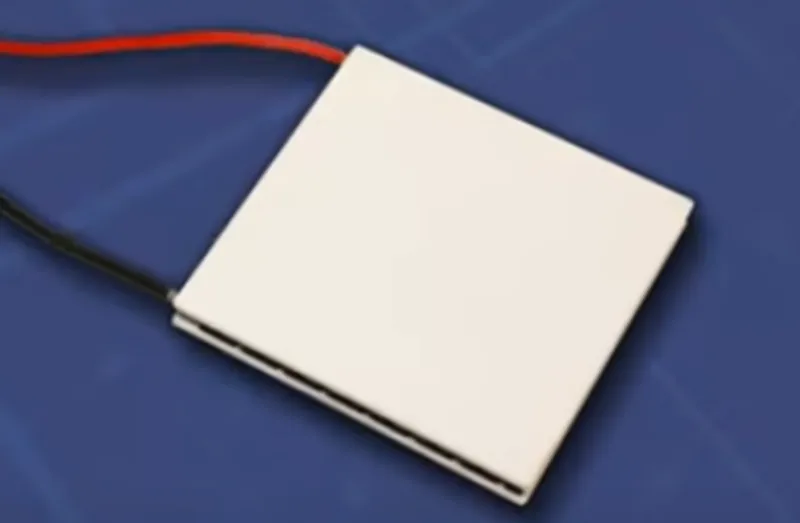
Thermoelectric Coolers, referred to as TEC for short, are commonly known as thermoelectric coolers, semiconductor cooling chips, or Peltier coolers in Chinese. They are solid-state cooling devices that realize direct conversion between electrical energy and thermal energy based on the thermoelectric effect (Peltier effect). Different from traditional compression refrigeration equipment (such as refrigerators and air conditioners), TEC has no mechanical moving parts such as compressors, refrigerants, and fans. It features small size, compact structure, fast response speed, high temperature control precision, no noise, no vibration, and bidirectional operation (switching between cooling and heating).
The core composition of TEC consists of an array of thermocouples formed by alternating arrangement of two different types of semiconductor materials (usually P-type and N-type semiconductors) connected by metal conductive plates, which are then encapsulated between ceramic substrates. Its working process does not rely on the phase change of working fluid. Only by applying a directional DC current can a stable temperature difference be formed at both ends of the device, achieving the effect of “cooling at one end and heat dissipation at the other”. Therefore, it is widely used in scenarios requiring precise temperature control and miniaturized cooling, such as electronic equipment heat dissipation, medical instrument temperature control, car refrigerators, and scientific research experimental devices.
1,Working Principle of Thermoelectric Coolers: Peltier Effect
The core refrigeration principle of TEC is the Peltier Effect, a thermoelectric conversion phenomenon discovered by French physicist Jean Charles Athanase Peltier in 1834. Its core logic is: when two different conductors or semiconductor materials form a closed loop and a DC current is passed through the loop, the current will induce directional transfer of thermal energy at the contact interface of the two materials—absorbing heat (refrigeration) at one interface and releasing heat (heat dissipation) at the other. The direction of heat transfer is related to the direction of the current, and reversing the current will swap the heat absorption and heat release interfaces.
Combined with the structure of TEC, its specific working process can be divided into the following 4 key steps:
2,Energy Difference of Carriers is the Foundation
The main carriers of P-type semiconductors are holes (positively charged), and the main carriers of N-type semiconductors are electrons (negatively charged). These two types of carriers have different energy level states. Without applying current, the carriers are in a state of disordered thermal motion, and the temperature at both ends of the device is uniform; when a DC current is applied, the current will drive the directional movement of the carriers, thereby carrying thermal energy to complete the transfer.
3,Current Drives Directional Migration of Carriers
When DC current passes through the thermocouple of TEC, under the action of the positive electrode of the power supply, the holes in the P-type semiconductor will move towards the N-type semiconductor, while the electrons in the N-type semiconductor will move towards the P-type semiconductor (the movement directions of the two are opposite, but the direction of the formed current is consistent). During this process, the carriers will absorb thermal energy from the “cooling end” of the device to increase their own energy, thereby meeting the demand for directional migration.
Formation of Heat Absorption at Cooling End and Heat Release at Heat Dissipation End
After the carriers carry the absorbed thermal energy to the other end (heat dissipation end) of the device, they will exchange energy with the metal conductive plate or semiconductor interface and release the carried excess thermal energy. At this time, the cooling end continuously loses thermal energy, resulting in a decrease in temperature and achieving the refrigeration effect; the heat dissipation end continuously gains thermal energy, resulting in an increase in temperature. It is necessary to timely export the heat through a heat dissipation structure (such as a heat sink, fan). Otherwise, the excessive temperature of the heat dissipation end will offset the refrigeration effect and even damage the device.
Current Direction Determines Working Mode (Switching between Cooling and Heating)
The Peltier effect is reversible: when the direction of the DC current passing through the TEC is changed, the migration direction of the carriers will be reversed accordingly, leading to the exchange of heat absorption and heat release interfaces. This characteristic enables TEC to not only achieve refrigeration but also switch to heating mode when needed, without the need for additional heating devices, greatly improving its application flexibility.
4,Supplementary Note: Key Premise for TEC Operation
It should be noted that TEC itself cannot “eliminate” heat, but only realizes the directional transfer of heat. Therefore, the core premise for the normal operation of TEC is that the heat generated at the heat dissipation end must be exported in a timely manner. If heat dissipation is not timely, the temperature of the heat dissipation end will continue to rise. When the temperature difference between the heat dissipation end and the cooling end exceeds the maximum allowable temperature difference of the device, the refrigeration effect of TEC will be completely lost, and even the semiconductor material may be damaged due to overheating.
In addition, the refrigeration power and refrigeration efficiency of TEC are affected by many factors, including semiconductor material performance, number of thermocouples, magnitude of applied current, and temperature difference between the two ends. At present, the refrigeration efficiency of TEC is lower than that of traditional compression refrigeration equipment, so it is more suitable for low-power, high-precision temperature control scenarios rather than large-scale refrigeration needs.
5,Summary of Core Features
• Solid-state structure, no mechanical moving parts, no noise, no vibration, and long service life;
• Small size, light weight, easy to integrate into small equipment;
• Fast response speed (millisecond level) and high temperature control precision (up to ±0.1℃);
• Bidirectional operation of cooling/heating can be achieved by switching the current direction;
• Reliable operation, adaptable to harsh environments (such as vacuum, high temperature, and vibration environments);
• Relatively low refrigeration efficiency, suitable for low-power, high-precision temperature control scenarios.