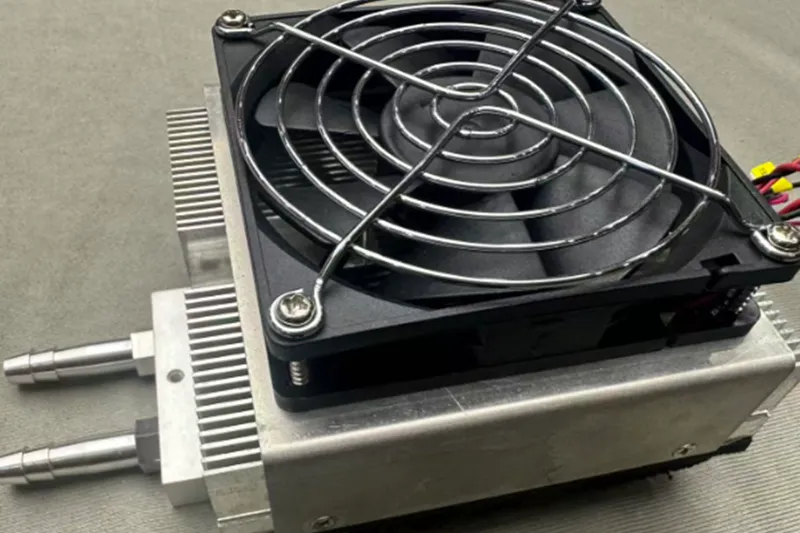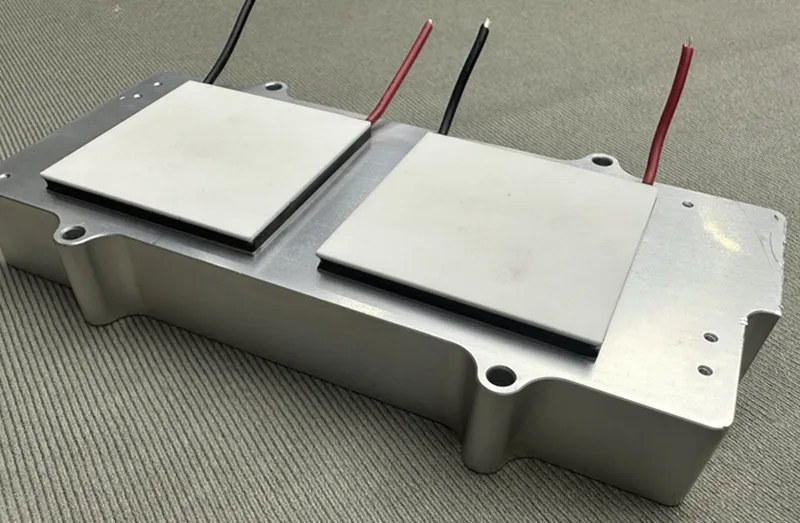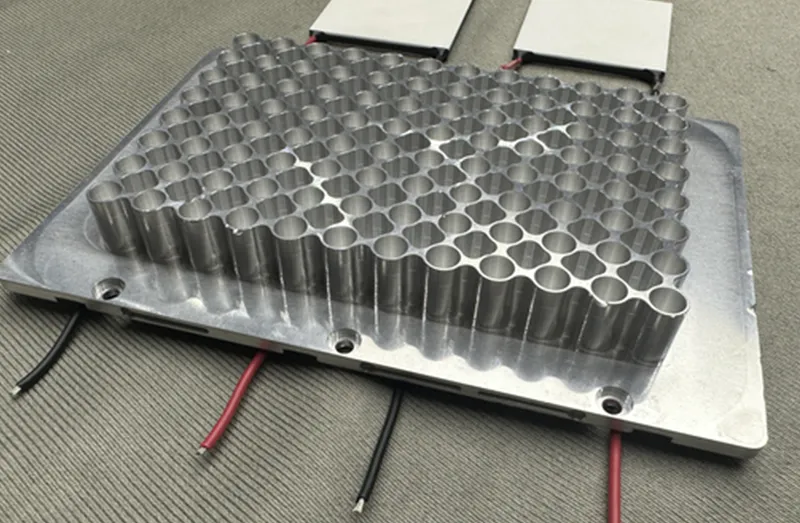
As a key device in the field of solid-state refrigeration, the TEC Refrigeration Module achieves cooling by leveraging the unique properties of semiconductor materials, completely freeing itself from the reliance on refrigerants that is inherent in traditional refrigeration technologies. Its core working component is the thermoelectric cooling chip (referred to as TEC for short), which is why it is also commonly known as the semiconductor refrigeration module.
The refrigeration mechanism of the TEC Refrigeration Module is based on the Peltier Effect: when a direct current is passed through the thermoelectric cooling chip, the semiconductor materials inside the chip undergo an energy transfer process. The cold-end area continuously absorbs heat from the surrounding environment, while the hot-end area releases heat simultaneously. Through this directional “heat migration”, the temperature of the cold end keeps dropping, thereby providing cooling effects for the target object that requires temperature reduction.
When broken down from a structural perspective, a complete TEC Refrigeration Module operates with the collaboration of three core components, each assuming a crucial role:
1. Hot-side contact component: It serves as the “heat discharge channel” of the module, closely attached to the hot end of the TEC. Its core task is to quickly conduct away the heat accumulated at the hot end, preventing heat buildup from affecting refrigeration efficiency and ensuring the stable progress of the entire refrigeration process.
2. Thermoelectric cooling chip (TEC): Acting as the “power core” of the module, it is responsible for converting the input electrical energy into the driving force for heat transfer. It is the key carrier for realizing the refrigeration function, and without it, the directional heat transfer cannot be achieved.
3. Cold-side contact component: It is in direct contact with the object that needs temperature control and functions as the “cold energy transfer interface”. It transfers the low temperature from the cold end of the TEC to the target object, ultimately fulfilling the requirement of cooling and temperature control for the target object.
The commonly used refrigeration module series can be divided into various series, such as DA, DN, AA, NN, DL, AL, DD, NA, LL, etc., based on the different contact methods between the hot and cold surfaces. Among them, DA, AA, DL, AL, and LL are the five most widely used series, suitable for different temperature control scenarios and heat dissipation needs.
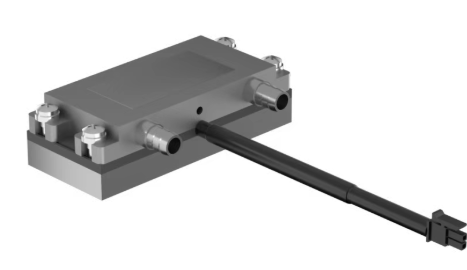
The DA series module adopts air-cooled cooling method, mainly used for contact cooling of solid objects, such as chips, liquid on carrier chips, etc. Its characteristic is to directly contact the temperature controlled object through metal aluminum parts, which can quickly transfer heat and achieve a high rate of temperature rise and fall.
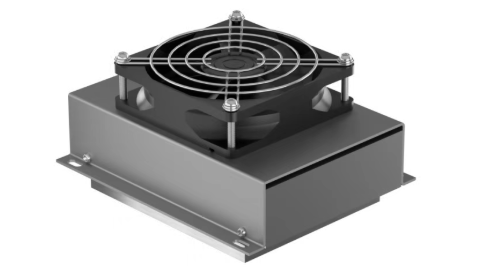
DL series: Compared to DA series modules (air-cooled heat dissipation), DL series modules (water-cooled heat dissipation) typically achieve higher heating and cooling rates, while also achieving greater temperature differences between the cold and hot surfaces (such as using 6L/min of 25 ℃ cooling water for heat dissipation, the lowest temperature of the cold surface aluminum block can reach -25 ℃). If you have a higher demand for temperature control speed and temperature difference, the DL series water-cooled module would be a better choice.
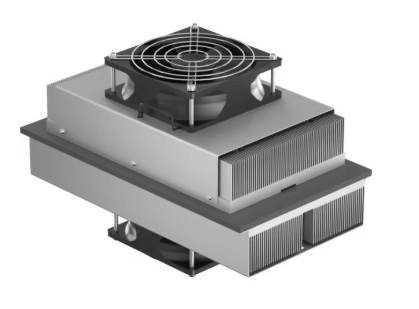
AA series: The AA series module adopts a dual fan design, suitable for scenarios that require overall temperature control of the space, such as car refrigerators, refrigerated boxes, constant temperature makeup boxes, small computer rooms, etc. It uses the cooperation of fans and air ducts to make air flow, achieving unified temperature control of the space and ensuring that the ambient temperature is in an ideal state.
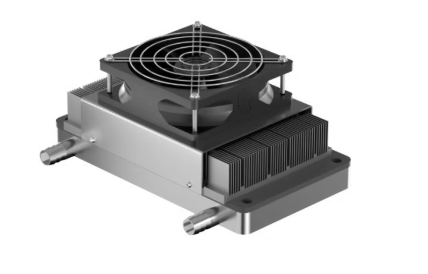
AL series: When devices have high heat dissipation requirements and limited installation space, AL series modules will be the ideal choice. It adopts water cooling for heat dissipation, which not only has better cooling effect than air cooling, but also significantly reduces its volume, making it more convenient to be embedded in various precision equipment.
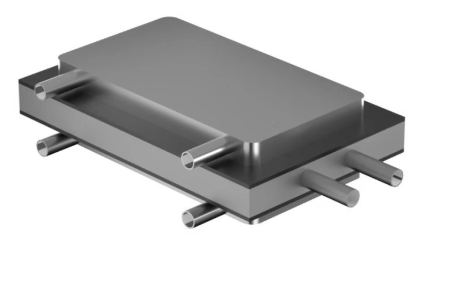
LL series: The LL series module is designed specifically for liquid temperature control, with a maximum cooling capacity of up to 3000W, capable of meeting high-power cooling needs. It can be directly connected to factory water or domestic water without the need for complex cooling systems, and has the advantages of easy installation and simple maintenance. This series of modules is widely used in industrial temperature control platforms, medical equipment and other fields, and is an ideal alternative to 1-1.5 horsepower compressors.
TEC module selection – evaluation of refrigeration capacity is crucial when using TEC refrigeration modules.
The target cooling capacity QC not only depends on the heating situation of the heat source itself (Q active), but also closely related to the heat exchange between the heat source and the surrounding environment (Q passive). Understanding the calculation logic of QC is the first step towards achieving precise temperature control. Here is its calculation formula: QC=Q active+Q passive (Q passive 1+Q passive 2) Q active=UI (voltage X current) Q passive 1=CM ∆ t (heat capacity X mass X temperature difference) Q passive 2=hcA ∆ t (heat transfer coefficient X surface area X temperature difference)
After clarifying the target cooling capacity, if the customer has provided the structural dimensions and heat dissipation method, the thermal resistance between the cold and hot surfaces can be further calculated, and combined with the required cooling capacity, operating voltage, and current parameters, the selection and matching of TEC modules can be completed. 04 TEC Module Selection – Performance Coefficient Evaluation In addition, as the core component of TEC refrigeration modules is semiconductor refrigeration chips, their performance coefficient COP depends not only on materials and manufacturing processes, but also on various other factors such as cooling methods (air/water cooling, etc.), TEC layout, insulation design, selection of contact interface materials, installation methods, etc.
① Air cooling heat dissipation: COP is usually between 0 and 1.0;
② Water cooling heat dissipation: COP can be increased to 1.2;
③ When the temperature difference between the hot and cold surfaces is small and the voltage can be flexibly adjusted: the COP of the water-cooled module can reach 1.5 or above;
④ When the temperature has reached the set value: the system only requires a small amount of power consumption for temperature control, and the COP is significantly improved at this time.