
1. Abstract
TEC heat dissipation optimization. The cooling temperature difference, operating efficiency and service life of thermoelectric cooler (TEC) refrigeration systems are completely determined by the hot-end heat dissipation capability. Insufficient heat dissipation is the core cause of TEC cooling attenuation, high-temperature failure and burnout. This paper conducts a comprehensive benchmark study on three mainstream heat dissipation solutions: air cooling, water cooling and heat pipe cooling. It compares the heat dissipation efficiency, load performance and working condition adaptability of the three schemes through quantified measured data. Based on years of industrial thermal management project experience of ZICOTEC, this article systematically sorts out the advantages, disadvantages and applicable scenarios of the three heat dissipation structures. Comparative tests of heat dissipation performance under identical TEC chip conditions are carried out, and the selection priority of heat dissipation methods for different equipment and working conditions is finally clarified, providing practical technical references for the design and optimal selection of heat dissipation schemes for semiconductor refrigeration equipment.
2. Structure, Cost and Applicable Working Conditions of Air Cooling
Air cooling is the most popular and basic heat dissipation solution for TEC refrigeration equipment. It realizes hot-end heat exchange through forced convection with aluminum heat sinks and fans. Featuring a simple structure, high stability and convenient maintenance, it is the preferred heat dissipation method for civil and ordinary industrial TEC equipment. The complete system consists of cooling fins, DC fans, thermal grease and fixing pressure strips, with no liquid medium or sealing pipeline, resulting in no risk of liquid leakage or corrosion.
In terms of structural characteristics, the air cooling solution boasts a high degree of modularization, simple assembly and strong compatibility, adapting to most conventional TEC chip sizes. ZICOTEC optimizes the fin spacing, base thickness and air duct structure for conventional air cooling working conditions, effectively reducing air resistance, improving convective heat exchange efficiency, and solving the common problems of uneven heat dissipation and local heat accumulation of ordinary air cooling systems. Air cooling equipment has no complex accessories, requires almost no subsequent maintenance, and features a much lower failure rate than liquid cooling and heat pipe solutions.
In terms of cost, air cooling has low raw material costs, mature mass production processes and low assembly costs, delivering extremely high cost performance and suitable for mass production of standardized equipment. However, it has obvious shortcomings: the heat dissipation upper limit is low, and the heat exchange efficiency is greatly affected by ambient temperature, wind speed and dust. Under high-load and long-term continuous operating conditions, insufficient heat dissipation margin will cause a significant rise in TEC hot-end temperature and severe attenuation of cooling temperature difference.
In terms of comprehensive working condition adaptability, air cooling is only applicable to normal temperature environments, intermittent operation, low-power and low-precision temperature control scenarios, such as small household refrigeration modules, ordinary vehicle-mounted refrigerators and short-term auxiliary refrigeration equipment. It is not suitable for high-temperature environments, 24-hour continuous operation and high-precision industrial temperature control equipment.
3. High-Temperature Performance Advantages of Water Cooling
Water cooling (liquid cooling) is an industrial-grade high-efficiency heat dissipation solution, composed of a water cooling plate, circulating water pump, water tank and diversion pipeline. Relying on the high specific heat capacity and high heat exchange efficiency of liquid media, it quickly removes accumulated heat from the TEC hot end, serving as the core heat dissipation solution for high-load and large-temperature-difference TEC systems. Compared with air cooling, water cooling features higher heat exchange density, more stable temperature control and stronger anti-interference capability against environmental changes.
The core advantages of water cooling are fully reflected in high-temperature, high-load and large-temperature-difference working conditions. Air has a low specific heat capacity, so the heat exchange efficiency of air cooling drops sharply in high-temperature environments. In contrast, water cooling media feature stable temperature and large heat capacity, which can continuously and evenly take away heat from the TEC hot end, effectively suppress chip temperature rise, maintain the maximum cooling temperature difference of TEC, and avoid refrigeration failure under high-temperature conditions. ZICOTEC industrial-grade water cooling plates adopt a proprietary micro-channel structure design. Compared with conventional flow channels, they have a larger heat exchange area, lower thermal resistance and more uniform heat dissipation, perfectly meeting the long-term full-load operation requirements of high-power TEC chips and adapting to various high-end industrial temperature control scenarios.
Meanwhile, water cooling delivers excellent temperature uniformity without local hot spots caused by air cooling. It can greatly reduce the local thermal stress of TEC chips, lower the risk of grain fatigue and substrate cracking, and significantly extend the service life of chips. In terms of noise performance, water cooling can replace high-speed and high-air-volume fans to reduce equipment operating noise, making it suitable for silent scenarios such as laboratories, medical equipment and precision instruments.
The limitations of water cooling lie in its complex structure, high cost and regular maintenance requirements. It has potential risks of pipeline aging and liquid leakage, so it is not suitable for simple and low-cost equipment, and only applicable to high-end industrial precision refrigeration scenarios.
4. Lightweight Application Characteristics of Heat Pipe Cooling
Heat pipe cooling is a high-efficiency uniform heat dissipation solution developed for miniaturized, lightweight and compact equipment. It combines the simplicity of air cooling and the high efficiency of water cooling, realizing rapid heat equalization and conduction through the phase change heat transfer principle inside the heat pipe, and serves as an optimal upgraded solution for small and medium-sized precision TEC equipment.
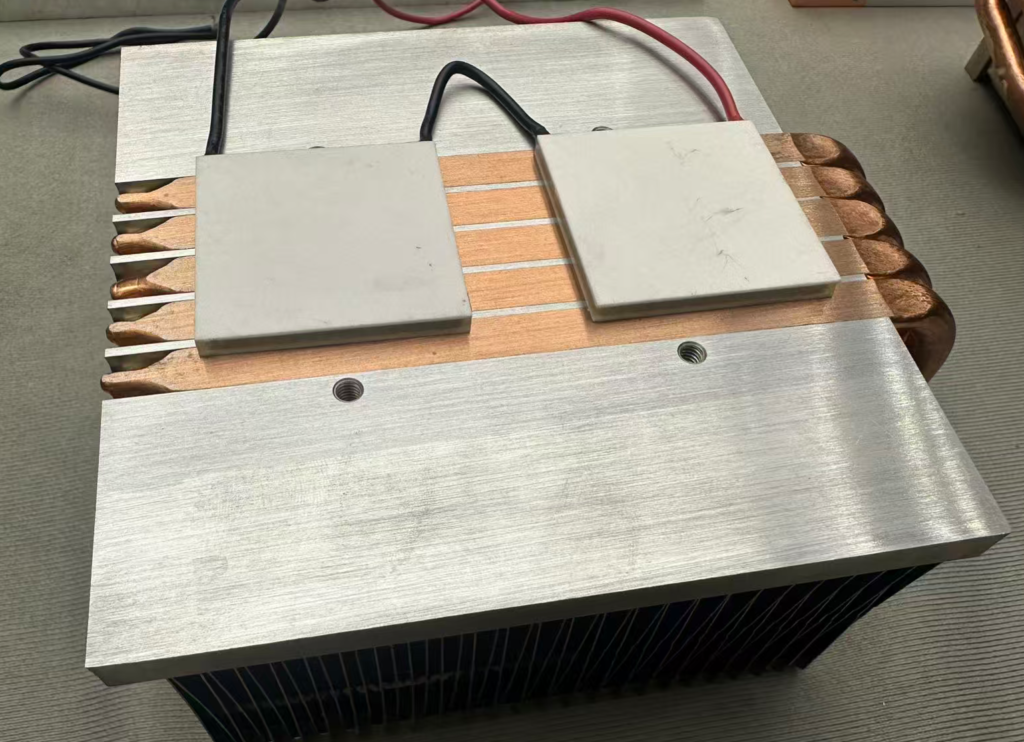
The core characteristics of heat pipe cooling are light weight, thin profile, zero power consumption and excellent heat uniformity. Compared with bulky high-density fin air cooling radiators, heat pipe modules have smaller size and lighter weight, occupying no internal equipment space. Compared with water cooling, they require no water pump circulation or pipeline layout and have no liquid leakage risk, featuring a simpler structure and higher reliability. Relying on phase change heat transfer, the thermal conductivity of heat pipes is far higher than that of pure aluminum and pure copper, which can quickly diffuse the concentrated heat from the TEC hot end to the cooling fins and completely eliminate local heat accumulation.
ZICOTEC lightweight heat pipe cooling modules are customized and optimized for miniature TEC refrigeration systems. Conventional ZICOTEC radiators are equipped with built-in heat pipe structures to further enhance heat equalization and thermal conductivity, effectively improving the common defects of local heat accumulation and uneven heat dissipation of ordinary air cooling. They are perfectly adapted to ultra-thin equipment, embedded equipment and portable temperature control equipment, balancing high-efficiency heat dissipation and structural limitations. Under medium and low load conditions, heat pipe cooling efficiency is far superior to ordinary air cooling, with temperature uniformity close to water cooling, delivering extremely high comprehensive cost performance.
Its main limitation is limited ultimate heat dissipation capacity. It cannot support full-load high-temperature operation of ultra-high-power TEC chips or adapt to equipment with ultra-high heat flux density, and is only suitable for lightweight, compact and medium-low load precision refrigeration scenarios.
5. Comparative Test of Heat Dissipation Efficiency Under Identical TEC Chips
To objectively quantify the performance gaps among the three heat dissipation solutions, ZICOTEC adopts the same TEC12706 chip with unified 12V regulated power supply and 25℃ constant ambient temperature. A 30-minute steady-state comparative test is carried out with standard air cooling, conventional water cooling and heat pipe cooling modules respectively, recording hot-end temperature rise, maximum cold and hot end temperature difference, and steady-state temperature difference attenuation data.
5.1 Temperature Rise Data Comparison
Air cooling: steady-state hot-end temperature rise of 48℃ within 30 minutes, with obvious and continuously climbing heat accumulation; Heat pipe cooling: steady-state hot-end temperature rise of 32℃ within 30 minutes, with gentle temperature rise and excellent heat uniformity; Water cooling: steady-state hot-end temperature rise of 18℃ within 30 minutes, with sufficient heat dissipation margin and stable temperature rise.
5.2 Cooling Temperature Difference Stability Comparison
Air cooling: maximum temperature difference of 30℃ with 35% steady-state attenuation and severe temperature control drift; Heat pipe cooling: maximum temperature difference of 38℃ with 12% steady-state attenuation and moderate stability; Water cooling: maximum temperature difference of 43℃ with only 4% steady-state attenuation and full-process stable refrigeration.
5.3 Test Conclusion
Under identical chips and working conditions: water cooling delivers the strongest ultimate performance and optimal stability; heat pipe cooling has the highest comprehensive cost performance and outstanding lightweight advantages; ordinary air cooling has the lowest ultimate performance and severe attenuation, only meeting basic refrigeration requirements.
6. Conclusion: Priority Ranking of Heat Dissipation Selection
Combined with structural characteristics, measured data and a large number of ZICOTEC project implementation experiences, standardized TEC heat dissipation selection priorities are sorted out for different working conditions, precision requirements and equipment structural needs, facilitating rapid engineering selection.
1. High-precision, high-temperature, 24-hour continuous industrial scenarios: Priority → Water Cooling Water cooling is preferred for high-power, high heat flux density and high-precision constant temperature equipment to ensure ultimate temperature difference and long-term operational stability.
2. Lightweight, compact, medium-precision scenarios: Priority → Heat Pipe Cooling Heat pipe cooling is the first choice for space-limited, silent, lightweight and medium-low load precision equipment, balancing heat dissipation efficiency and structural advantages.
3. Low-cost, intermittent operation, conventional civil scenarios: Priority → Air Cooling Standard air cooling is suitable for cost-sensitive, intermittent start-stop and normal-temperature civil equipment, meeting basic usage requirements with the highest cost performance.
In general, the upper limit of TEC refrigeration performance is determined by the heat dissipation scheme. Reasonable matching of air cooling, heat pipe cooling and water cooling structures, combined with ZICOTEC standardized thermal management supporting solutions, can completely solve common TEC problems such as heat accumulation, cooling attenuation and high-temperature burnout, and maximize the temperature control performance of semiconductor cooling chips.