
1. Abstract
How to Follow the TEC Cold and Hot Side. Thermoelectric cooler (TEC) Peltier chips have almost identical structural appearance on both sides, which frequently leads to reverse installation of cold and hot sides, resulting in cooling failure and overheating burnout. Based on front-line engineering practical experience, this article systematically introduces multiple methods to distinguish TEC cold and hot sides, including power-on testing, appearance identification and printed code recognition. It deeply analyzes equipment faults and component damage risks caused by reverse installation, and shares efficient batch detection methods for mass inspection scenarios. As a professional manufacturer specializing in semiconductor refrigeration and thermal management solutions, ZICOTEC summarizes practical installation guidelines to provide standardized operation references for TEC assembly, mass production and after-sales debugging, effectively eliminating reverse installation failures from the source.
Keywords: TEC cold hot side; semiconductor refrigeration side identification
2. Principles of Power-On Identification Method
Power-on testing is the most accurate and universal method to distinguish TEC cold and hot sides, applicable to unmarked, blurred and second-hand chips. Relying on the Peltier effect, this method features high stability and zero error, and is adopted as a basic inspection procedure in ZICOTEC’s engineering quality control.
TEC chips realize directional heat migration after DC power input. With forward current input, one side continuously absorbs heat to form the cooling surface, while the other side releases heat to form the heat dissipation surface. In practical operation, low-voltage and short-time power supply is adopted to avoid thermal damage. Typically, powering on with 5V DC for 1 to 2 seconds can clearly identify temperature differences: the side that rapidly cools down and generates slight condensation is the cold surface, and the side that heats up quickly is the hot surface.
The core principle lies in the fixed thermoelectric conversion direction. The internal series structure of N-type and P-type semiconductor grains determines a stable heat transfer direction, which is not affected by chip size, power or batch differences. Low-voltage instantaneous power-on will not damage chip performance, making it suitable for both new product inspection and reused chip re-testing.
3. Appearance Marking and Printing Identification Rules
Formal mass-produced TEC chips are equipped with standardized surface prints and marks, enabling fast side identification without power supply. This high-efficiency method is widely adopted in ZICOTEC’s standardized mass production.
3.1 Surface Silk-Screen Marking Rules
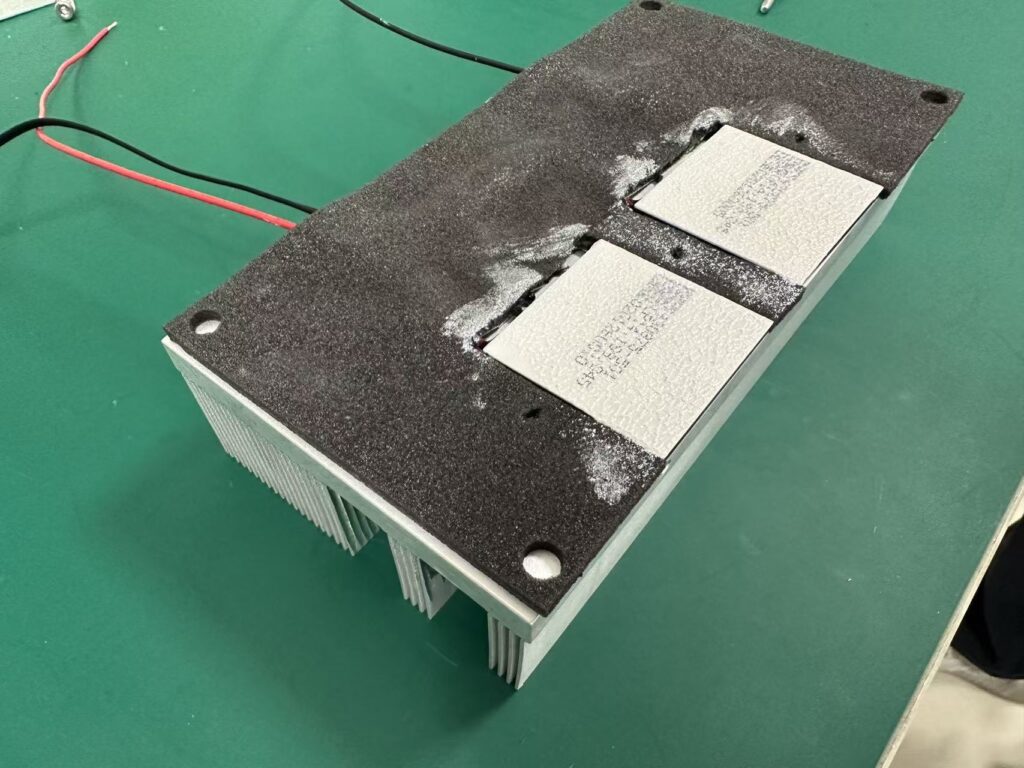
The universal industry standard confirms that the side printed with model parameters and brand LOGO is defined as the heat dissipation surface, while the smooth and blank side without printing is the cooling surface. This rule covers more than 95% of conventional civil and industrial TEC models.
3.2 Pin Layout Identification Rules
Pin layout serves as an auxiliary identification basis. For most conventional TEC chips, the side with pin outlets is the hot surface, and the opposite side is the cold surface. For customized special-shaped chips, refer to ZICOTEC official factory drawings to avoid identification errors.
3.3 Subtle Appearance Feature Identification
High-quality industrial TEC chips have distinguishable ceramic substrate craftsmanship. The cooling surface adopts a flat and hydrophobic process with uniform gloss and no impurities. The heat dissipation surface is optimized for tight fitting with heat sinks and liquid cold plates, presenting a slight frosted texture in most batches, which can be used as an auxiliary judgment standard.
4. Damage Analysis Caused by Reverse Installation
Reverse installation of TEC cold and hot sides is one of the most destructive operational errors in semiconductor refrigeration systems. It is a typical human-induced failure frequently encountered in ZICOTEC’s after-sales cases, causing irreversible component damage rather than quality defects.
4.1 Complete Loss of Cooling Capacity
Reverse installation completely reverses the heat migration direction. The originally functional cooling surface turns into a heat-releasing surface, making the equipment unable to cool down and even continuously raising the internal temperature, which leads to total cooling failure.
4.2 Rapid Overheating and Chip Burnout
TEC thermal structures including heat sinks and liquid cold plates are professionally matched for hot surface heat export. After reverse installation, the cold surface fits the heat dissipation structure, while the real hot surface is enclosed in a narrow cavity without effective heat dissipation. The internal temperature can exceed 100°C within tens of seconds, causing solder melting, grain carbonization and ceramic substrate cracking, resulting in permanent chip scrap.
4.3 Overall Temperature Control System Disorder
For precision closed-loop temperature control equipment, reverse installation triggers logical judgment errors. The control system continuously increases power output in misjudgment, further aggravating overload heating. This not only burns out the TEC chip, but also damages power modules, main control boards and sensors, leading to complete system failure.
5. Fast Batch Detection Methods for Mass TEC Chips
Single power-on testing is inefficient for mass production and batch quality inspection. Based on rich mass production experience, ZICOTEC establishes a set of standardized and high-efficiency batch identification solutions for large-scale assembly scenarios.
5.1 Batch Preliminary Screening by Appearance
Before mass assembly, inspectors uniformly screen chips according to silk-screen prints, LOGO and pin standards. Chips with clear marks can be directly distinguished without power-on testing, greatly improving production efficiency for conventional batch orders.
5.2 Low-Voltage Batch Power-On Testing
For unmarked, blurred and customized special-shaped chips, ZICOTEC adopts a unified 5V low-voltage batch test platform. Short-time power-on inspection realizes rapid and accurate side identification, balancing detection accuracy and production efficiency to avoid batch reverse installation risks.
5.3 Batch Marking and File Management
In ZICOTEC’s standardized production process, each TEC batch completes cold and hot side filing and marking. Meanwhile, matched heat sink and liquid cold plate assembly processes are unified to realize full-process standardized control from procurement and quality inspection to assembly, fundamentally eliminating batch reverse installation problems.
6. Conclusion: Key Practical Guidelines to Avoid Installation Errors
Combined with practical test data and mass production cases, as well as ZICOTEC’s long-term experience in semiconductor refrigeration and thermal supporting solutions, this section summarizes core operation guidelines for TEC side identification and standardized installation.
First, prioritize appearance identification for conventional chips, following the standard rule: printed LOGO side = hot surface, blank smooth side = cold surface. Second, unmarked or old chips must be verified by low-voltage short-time power-on testing to avoid empirical judgment errors. Third, reverse installation is strictly prohibited, which will directly cause overheating burnout and equipment failure. Fourth, mass production must implement dual inspection of appearance screening and power-on recheck, with batch process filing to guarantee yield rate.
Accurate cold and hot side identification and standardized installation are essential to guarantee thermoelectric cooler cooling efficiency and service life. Equipped with ZICOTEC’s high-precision heat sinks and liquid cold plate thermal solutions, TEC chips can exert optimal cooling performance, avoid common installation failures, and ensure long-term stable operation of precision temperature control equipment.