
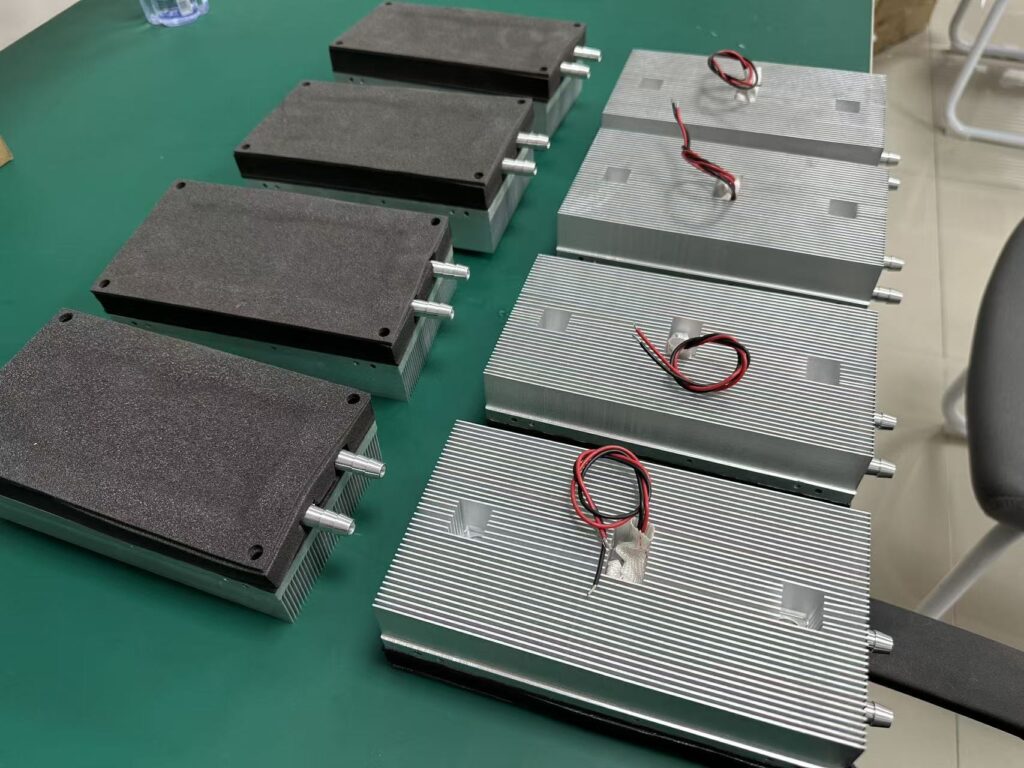
Thermoelectric cooler parameters.Widely adopted in optoelectronic communication, precision instrumentation, medical equipment, and miniature electronic temperature control systems, TEC (Thermoelectric Cooler) chips have become core components for high-precision thermal management. Featuring zero noise, zero refrigerant, fast thermal response, accurate temperature control and compact structure, TEC modules serve advanced precision cooling scenarios. Most common TEC failures, temperature control drift, excessive power consumption and shortened service life are essentially caused by improper parameter matching and insufficient understanding of core performance indicators.
The overall performance of TEC chips is determined by four core parameters: operating voltage, operating current, temperature difference (ΔT), and COP (Coefficient of Performance). These four indicators are interrelated and mutually restrictive, defining the cooling limit, operational stability and energy consumption level of thermoelectric modules. This article provides an in-depth and professional interpretation of TEC core parameters, covering basic definitions, working principles, parameter correlations, selection guidelines, practical troubleshooting and efficiency optimization. It offers reliable technical references for engineer selection, circuit design, operational debugging and product iteration, adapting to all industrial precision thermal management scenarios.
1,TEC Chip Voltage Parameter: Fundamental Operating Basis for Environmental Adaptation
Voltage is the basic electrical parameter for TEC startup and continuous temperature regulation. The maximum rated voltage (Vmax) refers to the upper limit of stable operating voltage under standard conditions, serving as the fundamental benchmark for circuit design and parameter configuration.
Based on the Peltier effect, voltage directly controls the carrier migration speed inside semiconductor materials. Higher voltage enhances instantaneous cooling power but simultaneously increases Joule heat loss. Standard single-stage TEC chips feature a Vmax range of 3V to 15V, while miniature precision TEC modules commonly adopt 5V, 10.5V and 12V specifications, perfectly matching low-voltage DC power supply for optical communication devices and miniature sensors.
In practical engineering applications, cooling performance is not positively correlated with voltage. The optimal operating voltage range is30%–80% of Vmax, which balances cooling efficiency and long-term operational stability. Continuous full-voltage operation generates excessive redundant heat, intensifies heat dissipation pressure on the hot side, accelerates component aging and drastically shortens service life. In contrast, operating below 30% Vmax results in insufficient cooling capacity and failure to reach targeted temperature differences for precision cooling demands.
Additionally, TEC chips only support stable DC voltage input. AC power or fluctuating voltage causes frequent switching of cold and hot ends, unstable temperature difference and even permanent chip burnout. Reverse voltage enables heating functions, allowing TEC modules to realize bidirectional cooling and heating control for constant-temperature equipment applications.
2. TEC Chip Current Parameter: Core Regulation Factor for Cooling Power
The maximum rated current (Imax) represents the maximum safe continuous current under standard heat dissipation conditions. It is a key indicator for classifying TEC power grades and designing driving circuits. Compared with voltage, current provides more direct and sensitive adjustment of instantaneous cooling capacity, making it the primary tuning parameter for engineers.
According to electrical power formula Pin = I × V, input power is linearly proportional to operating current under fixed voltage conditions. A moderate current increase effectively improves cooling output. However, once the current exceeds the rated threshold, internal Joule heat rises exponentially, resulting in a negative efficiency state where heat loss outweighs cooling gain and overall thermal regulation performance declines significantly.
Two core principles must be followed in practical selection and debugging. For conventional precision temperature control scenarios, the recommended operating current ranges from 50% to 70% of Imax to ensure sufficient cooling margin while minimizing thermal loss. For rapid instantaneous cooling requirements, 80%–90% Imax is acceptable for short-term operation, yet long-term full-current running is strictly prohibited to avoid thermal fatigue damage.
Different TEC specifications with varying thermopile pairs and semiconductor materials feature distinct Imax values. Miniature TEC modules apply to compact precision devices with low current demand, while industrial high-power TECs support heavy heat load dissipation. Driving circuit design must reserve sufficient current margin to prevent overload and overcurrent damage, which is critical for protecting TEC chips from burnout.
3. TEC Chip Temperature Difference (ΔT): Core Metric for Cooling Capacity
Temperature Difference (ΔT) is the most intuitive and critical parameter for TEC selection, defined as the temperature gap between the cold side and hot side of a thermoelectric module. The maximum temperature difference (ΔTmax) represents the ultimate cooling capability under standard test conditions.
Under standard ambient conditions (25°C room temperature with sufficient hot-side heat dissipation), single-stage TEC modules achieve a typical ΔTmax of 60°C–70°C, enabling the cold side to drop to approximately -35°C. Multi-stage cascaded TEC chips break single-stage limits and reach a maximum temperature difference above 130°C, satisfying ultra-low-temperature precision cooling requirements.
A common engineering misconception is that the rated ΔTmax is achievable under all working conditions. In fact, the actual temperature difference is strictly restricted by three key factors. First, hot-side heat dissipation efficiency determines effective ΔT; poor heat dissipation causes rapid temperature difference attenuation even at full power. Second, unstable voltage and current lead to fluctuating cooling performance and reduced ΔT. Third, high ambient temperature intensifies external thermal interference and lowers practical cooling efficiency, requiring high-grade TEC modules for harsh high-temperature environments.
In practical applications, ΔT directly determines the temperature control accuracy and cooling ceiling of precision equipment. High-precision optoelectronic devices such as laser transmitters, optical receivers and pump lasers are extremely sensitive to temperature fluctuations. Minor temperature drift leads to performance deviation. Therefore, matched ΔT-grade TEC modules and efficient heat dissipation structures are essential to maintain stable and reliable thermal regulation.
4,TEC Chip COP Efficiency: Benchmark for Energy Consumption and Cooling Cost Performance
COP (Coefficient of Performance) is a core evaluation index for TEC energy efficiency, energy-saving performance and operational economy, distinguishing high-quality thermoelectric modules from ordinary products.
Industry standard formula:COP = Qc / Pin = Qc / (I×V)
Qc refers to effective cold-side cooling capacity, while Pin represents total input electrical power. Simply put, COP reflects the energy utilization rate: a higher COP means less power consumption, lower thermal loss and better energy-saving performance.
TEC COP values vary dynamically with working conditions rather than remaining fixed. At zero temperature difference (ΔT = 0°C), heat loss is minimized and COP reaches its peak, with high-quality miniature TEC modules achieving a COP of 1.0–1.2. As the temperature difference increases, internal thermal loss rises continuously and COP declines sharply, dropping below 0.2 near ΔTmax. Although TEC efficiency is lower than traditional compression refrigeration (COP 3.0–5.0), its compact size, high precision, zero vibration and refrigerant-free design make it irreplaceable for precision thermal management scenarios.
For practical example, a standard TEC module with 55.3W input power and 27W effective cooling capacity delivers a COP of approximately 0.49, indicating nearly half of the input electricity generates effective cooling while the rest converts into waste heat requiring hot-side dissipation. This verifies the core TEC application logic: superior heat dissipation ensures higher COP, better stability and longer service life. Failed heat dissipation leads to COP collapse and overall system failure.
High-end TEC chips adopt high-performance bismuth-telluride semiconductor materials and precision packaging processes, improving carrier mobility, reducing internal thermal resistance and heat loss, and maintaining superior COP performance with lower failure rates and long-term operational costs.
5. Correlation Logic and Engineering Selection Rules of Four Core Parameters
TEC voltage, current, temperature difference and COP are dynamically balanced and mutually restrictive. Most operational failures stem from mismatched parameter configuration. Mastering their internal correlation is essential for accurate selection and efficient debugging.
1. Power correlation: Voltage and current jointly determine total input power. Higher power increases theoretical cooling ceiling but raises Joule heat loss, resulting in reduced COP and weakened temperature difference.
2. Trade-off between ΔT and COP: Larger required temperature difference demands higher input power and inevitably lowers energy efficiency, leading to higher power consumption under ultra-low-temperature working conditions.
3. Scenario-based adaptation: For conventional constant-temperature scenarios, prioritize high COP efficiency by operating within the optimal voltage and current range. For rapid cooling and large temperature difference requirements, moderately sacrifice energy efficiency to guarantee cooling performance, equipped with enhanced heat dissipation systems to offset thermal loss.
6. Common Parameter Misunderstandings and Practical Optimization Solutions
1. Misunderstanding 1: Full-power operation delivers optimal cooling performance. In fact, full voltage and full current cause excessive heat accumulation, sharply reduced COP and even decreased effective temperature difference, while severely shortening service life. Optimization: Long-term operation should be controlled within 30%–80% of rated power.
2. Misunderstanding 2: Rated ΔTmax can be directly adopted as actual cooling standard. Practical temperature difference is greatly affected by heat dissipation, ambient temperature and thermal load.Optimization: Reserve 10%–20% temperature difference margin during selection and configure high-efficiency heat dissipation modules.
3. Misunderstanding 3: Prioritize cooling power while ignoring COP efficiency. High-power low-COP TEC chips generate excessive heat, consume high energy and deliver poor long-term cost performance. Optimization: Precision constant-temperature scenarios prioritize high-COP modules to balance cooling performance and operational stability.
7. Conclusion
Voltage and current define the electrical boundary and input power of TEC chips; temperature difference represents the ultimate cooling capability; COP evaluates energy utilization efficiency and economic performance. These four dynamic and interactive parameters collectively determine the precision, stability, energy consumption and service life of TEC thermal management systems.
For high-end applications including optical communication, precision optoelectronics, medical equipment and industrial sensing, accurate parameter matching and avoidance of common debugging errors enable TEC modules to exert their core advantages of miniaturization, high precision and bidirectional temperature control, achieving stable, efficient and long-lasting precision thermal management.